
La Romea Strata
The Romea Strata
Guarda il video della Romea Strata
La Romea Strata era una rotta europea importante, percorsa dai pellegrini che partendo dall’Europa centro orientale affrontavano il cammino verso Roma: dal Mar Baltico attraversavano Estonia, Lettonia, Lituania, Polonia, Repubblica Ceca e Austria fino a valicare le Alpi ed entravano nel Nord Est d’Italia attraverso il Tarvisio.
Prima di diventare via di pellegrinaggio, questo itinerario veniva usato per molteplici scopi tra cui quello commerciale: da qui passava l’ambra, il sale, il ferro, la seta… Il passaggio umano ha portato anche allo sviluppo della cultura, attraverso l’arte e l’architettura che incontriamo oggi lungo questa direttrice (ospitalità, chiese, musei, memorie…). La via è stata percorsa anche da menti illuminate che hanno lasciato il segno nella scienza, come Copernico, Keplero e Galileo Galilei, ma anche da figure cruciali che hanno diffuso attraverso questa via, oltre al cristianesimo, l’ebraismo e il protestantesimo.
Per percorrerla tutta, conoscerla in tutte le vesti che ha indossato nel tempo, viverla in tutti i suoi “strati”, non basterebbe una vita, e da qui il nome “STRATA” che vuol dire strada, ma anche, e soprattutto, stratificazione di storia e di vite.
47 tappe che si snodano lungo 5 regioni italiane per la bellezza di 1000 km. Il più vasto e vivo sistema di strade di un pellegrinaggio antico ancora oggi percorribile.
Un cammino affascinante che ti porta per mano lungo la nostra bella Italia, con tutto il suo bagaglio culturale e naturalistico, ammirando uno dei Paesi più amati al mondo, facendoti scoprire il fascino di questi luoghi spesso ancora incontaminati, con panorami mozzafiato, silenziosi boschi e incredibili scenari artistici e culturali. Un cammino in cui conoscerai non solo il territorio e la sua gente, ma anche, se vorrai, te stesso.
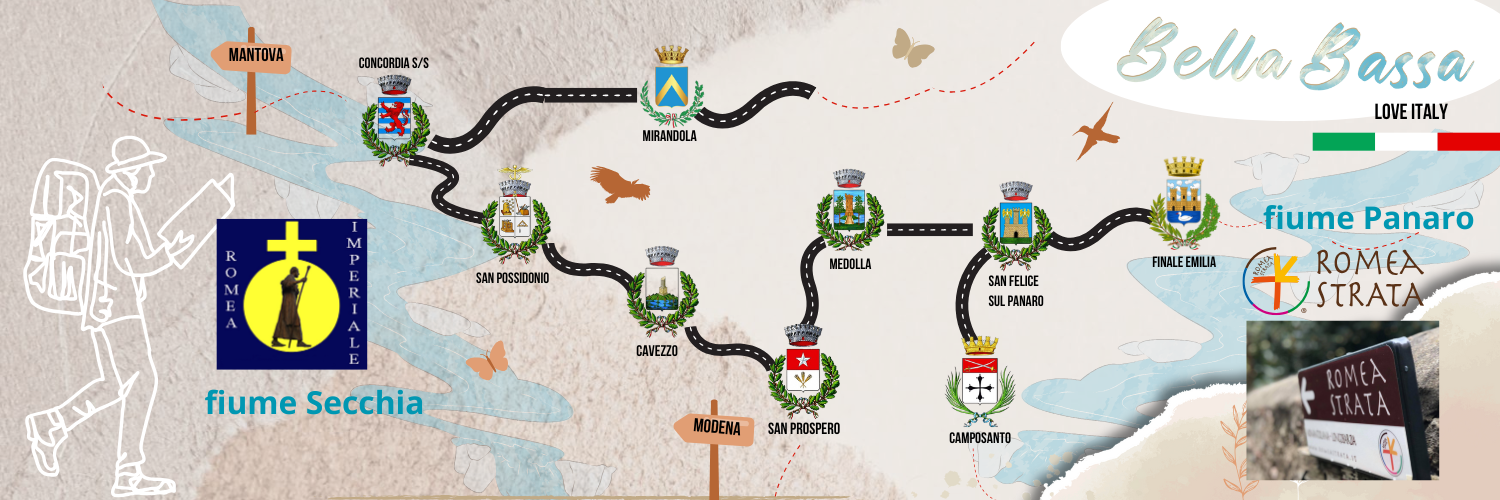
I comuni attraversati nella bassa modenese sono Finale Emilia e Camposanto

Per informazioni è possibile contattare
https://www.romeastrata.org/
Si ringrazia l'associazione Romea strata per la gentile concessione delle foto.

The Romea Strata was an important European route traveled by pilgrims who set out from Central and Eastern Europe on their journey to Rome: from the Baltic Sea, they crossed Estonia, Latvia, Lithuania, Poland, the Czech Republic, and Austria before crossing the Alps and entering northeastern Italy via Tarvisio. Before becoming a pilgrimage route, this itinerary was used for many purposes, including trade: amber, salt, iron, silk, and other goods passed through here. Human passage also led to cultural development, through the art and architecture that we encounter today along this route (hospitality, churches, museums, memories, etc.). The route was also traveled by enlightened minds who left their mark on science, such as Copernicus, Kepler, and Galileo Galilei, but also by crucial figures who spread Christianity, Judaism, and Protestantism along this route.
To travel its entire length, to get to know it in all the guises it has worn over time, to experience it in all its “layers,” a lifetime would not be enough, hence the name “STRATA,” which means road, but also, and above all, the stratification of history and lives. 47 stages winding through 5 Italian regions for a total of 1000 km. The largest and most vibrant network of roads of an ancient pilgrimage route that can still be traveled today. A fascinating journey that takes you by the hand through our beautiful Italy, with all its cultural and natural heritage, admiring one of the most beloved countries in the world, allowing you to discover the charm of these often unspoiled places, with breathtaking views, silent woods, and incredible artistic and cultural scenery. A journey in which you will get to know not only the territory and its people, but also, if you wish, yourself.
The municipalities crossed in the lower Modena area are Finale Emilia (MO) and Camposanto (MO).